TL;DR
- Alimony is deductible by the payer and taxable to the recipient only under an instrument executed before 2019.
- For instruments executed after December 31, 2018, the payer can’t deduct it and the recipient doesn’t report it federally.
- A pre-2019 agreement modified later keeps the old rules unless the modification expressly adopts the new ones.
- A grandfathered agreement must still meet the old alimony tests, including ending at the recipient’s death.
- State returns can differ. California kept the old treatment for 2019 to 2025 agreements, and New York still uses it.
- Confirm current IRS and state guidance before you advise a client.
A client signed a divorce agreement in 2016 and now wants to lower the monthly payment. For an agreement like that, the answer to “is alimony tax deductible” is usually yes, and changing the amount doesn’t end the deduction on its own. The full answer depends on when the instrument was executed, what any modification says, and which state return applies, which is what a Certified Divorce Financial Analyst® or attorney needs to check.
Tax rules change. This article is general information and isn’t tax or legal advice, so confirm current IRS and state rules before you rely on it.

Is Alimony Tax Deductible?
Alimony is tax deductible only when it’s paid under a divorce or separation instrument executed on or before December 31, 2018. Under those older instruments, the payer deducts the payments and the recipient reports them as income. For instruments executed after that date, neither happens on the federal return.
Under IRS Tax Topic 452, the payer can take the deduction whether or not they itemize. The payer must list the recipient’s SSN or ITIN, or the deduction may be disallowed and a $50 penalty may apply.
Definition: Divorce or separation instrument. The written document that creates the support duty: a divorce or separate maintenance decree, a written instrument incident to that decree, a written separation agreement, or a court order requiring support, including a temporary order. The tax rule turns on the date this instrument was executed, and the date payments start doesn’t change it.
How much alimony a court sets is a separate question, covered in our guide to what alimony is based on.
What Changed in the 2017 Tax Law
The Tax Cuts and Jobs Act, Public Law 115-97, signed December 22, 2017, repealed the alimony deduction in former IRC section 215 and the matching income rule in former section 71. Section 11051 made the repeal apply to instruments executed after December 31, 2018, and to older instruments only if a later modification expressly adopts it.
The effective-date language in section 11051(c) of Public Law 115-97 applies the change to:
“(1) any divorce or separation instrument … executed after December 31, 2018, and (2) any divorce or separation instrument (as so defined) executed on or before such date and modified after such date if the modification expressly provides that the amendments made by this section apply to such modification.”
The old system worked as an income shift. The payer usually sat in a higher tax bracket than the recipient, so moving income onto the recipient’s return lowered the couple’s combined tax.
Old Rules vs New Rules: The Rule Chart
Two facts decide the treatment: when the instrument was executed, and whether a later modification expressly adopted the new rules. Each case fits one row below.
| Instrument | Federal: payer | Federal: recipient | California return | New York return |
|---|---|---|---|---|
| Executed on or before Dec. 31, 2018, and never modified, or modified without adopting the new rules | Deducts | Reports as income | Same as the old federal rule | Same as the old federal rule |
| Executed on or before Dec. 31, 2018, and modified after 2018 with language expressly adopting the new rules | No deduction | Not income | Generally keeps the old treatment unless a change made after 2025 expressly adopts SB 711. Confirm with counsel. | Follows the federal result unless the change also expressly adopts the Tax Law § 612(w) modifications, which keep the old treatment. Confirm with counsel. |
| Executed Jan. 1, 2019, through Dec. 31, 2025 | No deduction | Not income | Deducts and reports as income (Schedule CA adjustment) | Deducts and reports as income (IT-225 codes S-136 and A-119) |
| Executed on or after Jan. 1, 2026 | No deduction | Not income | No deduction and not income (follows the federal rule) | Deducts and reports as income (per the 2025 IT-225 instructions) |
Key Insight: The date that matters is when the instrument was executed, and a temporary order or written separation agreement can be an instrument too. If one was signed in 2018 and the final decree in 2019, get a tax professional’s read on which one controls.
What Happens When a Pre-2019 Agreement Is Modified
A modification made after 2018 doesn’t end the deduction on its own. The new rules apply only if the modification expressly says they do, so a change to the amount that says nothing about taxes keeps the old treatment. The real risks are opt-in language and changes that break the old definition of alimony.
The “Expressly Provides” Test
The test asks whether the modification document itself says the new rules apply. If it does, the payer loses the deduction and the recipient stops reporting the payments. If it doesn’t, nothing changes on the federal return.
IRS Publication 504 says the new treatment reaches a pre-2019 instrument “modified after 2018, if the modification expressly states that the alimony isn’t deductible to the payer or includible in the income of the recipient.”
Watch Out: A modified order that is silent on taxes leaves both spouses on the old rules. If the parties want to switch, the document has to say so, and if they want to keep the old treatment, saying that in writing helps head off a later dispute.
A Grandfathered Agreement Still Has to Pass the Old Alimony Test
Keeping the old tax treatment means keeping all of the old rules. The modified obligation must still meet the former section 71 requirements, including no liability to pay after the recipient’s death, or the deduction can be lost even if the 2017 law is never mentioned.
A September/October 2026 Florida Bar Journal article on grandfathered alimony sorts changes by risk. Lowering the amount while keeping the termination terms is low risk. Converting to a fixed term, a nonmodifiable stream or a lump sum needs closer review.
The article cites Muñiz v. Commissioner, 661 Fed. App’x 1027 (11th Cir. 2016), where installment payments under a “lump sum alimony award” weren’t deductible because the instrument was silent on whether the obligation ended at the recipient’s death.
Pro Tip: Raise these points with counsel before signing. The modification should state that only the amount or payment terms change, say whether the parties intend to keep the pre-2019 tax treatment, and confirm that payments end at the recipient’s death with no substitute payment.
Term changes are common, so check how long alimony lasts under the state’s rules first. When the tax result is in play, model both versions of the deal before the client signs.
When a modification could change who pays tax on support, compare both versions first. SecureSplit® lets you enter verified tax figures and see each version’s after-tax cash flow side by side with property division and support. See how SecureSplit® works for financial professionals.
How the Rule Change Shifts After-Tax Support
Under the old rules, the payer’s tax savings covered part of each alimony dollar. Under the new rules the payer carries the full cost, so the same payment costs the payer more, and a payment set to the same payer cost leaves the recipient with less.
Take $3,000 a month ($36,000 a year). Assume a 30% combined marginal rate for the payer and 15% for the recipient. These are round numbers for illustration and don’t match any actual 2026 bracket.
| Item | Old rules (pre-2019 instrument) | New rules, same payment | New rules, same payer cost |
|---|---|---|---|
| Annual alimony paid | $36,000 | $36,000 | $25,200 |
| Payer’s tax savings | $10,800 | $0 | $0 |
| Payer’s after-tax cost | $25,200 | $36,000 | $25,200 |
| Recipient’s tax on alimony | $5,400 | $0 | $0 |
| Recipient keeps after tax | $30,600 | $36,000 | $25,200 |
At the same $36,000 payment, the payer’s cost rises by $10,800 a year. If the payment is cut until the payer’s cost matches the old $25,200, the recipient keeps $5,400 less, which is the net tax the two spouses used to save together.
Key Insight: Under the new rules, the payer is taxed on income they hand to a former spouse, and the recipient gets it tax-free. That is the trade Congress made, and it’s why the same support number is a different deal depending on the instrument date.
Real cases need the professional’s verified figures, including state tax. This view belongs in the CDFA® financial planning process and in divorce cash flow planning.
State Income Tax Can Follow Different Rules
State returns don’t always follow the federal alimony rule. California and New York are two large examples, and they now differ from each other.
California. The California Franchise Tax Board says the state did not conform for instruments executed January 1, 2019, through December 31, 2025, so payers still deduct and recipients still report that alimony through a Schedule CA adjustment. Under SB 711, instruments executed on or after January 1, 2026, follow the federal rule, and an older instrument modified later switches only if the modification expressly says the SB 711 amendments apply. Starting with tax year 2025, Schedule CA asks for the month and year of the agreement.
New York. New York’s 2025 Form IT-225 instructions still have recipients add alimony back (code A-119) and payers subtract it (code S-136) for instruments executed after December 31, 2018. A modified pre-2019 instrument gets that treatment only if the modification expressly adopts the Tax Law § 612(w) modifications.
Watch Out: A client can be on the new federal rule and the old state rule at the same time. Check the state return every time, and don’t assume other states follow either example.
SecureSplit® also includes state-specific child and spousal support calculators in all 50 states for the support amount itself.
What Counts as Alimony for Tax Purposes
For a pre-2019 instrument, a payment is deductible alimony only if it meets every Topic 452 requirement. Child support never counts. Each payment must meet these tests:
- No joint return between the spouses.
- Paid in cash, by check or by money order.
- Paid to or for a spouse under a divorce or separation instrument.
- If legally separated under a decree, not members of the same household.
- No liability to pay after the recipient’s death.
- Not treated as child support or a property settlement.
- Not designated in the instrument as not includible and not deductible.
Child support, noncash property settlements, community property income, payments to keep up the payer’s property, use of the payer’s property and voluntary payments never count. If the payer pays less than the total alimony and child support due, the payments go to child support first.
Watch for recapture too. If third-year alimony drops by more than $15,000 below the second year, or the second- and third-year payments drop sharply below the first, the payer may have to add back part of the earlier deduction. The payer reports alimony on Schedule 1 (Form 1040) lines 19a to 19c, and the recipient uses lines 2a and 2b.
Pro Tip: Recipients on pre-2019 agreements should plan for the tax during the year. Publication 504 says that if you receive alimony, “you may have to make estimated tax payments,” and underpaying can lead to a penalty.
Where SecureSplit® Fits
The tax rule decides whose return carries the alimony. The professional still has to show what that means for cash flow over the full term, and SecureSplit® gives CDFA® professionals and attorneys one place to enter verified tax figures and compare after-tax cash flow for each scenario, side by side with property division and support.
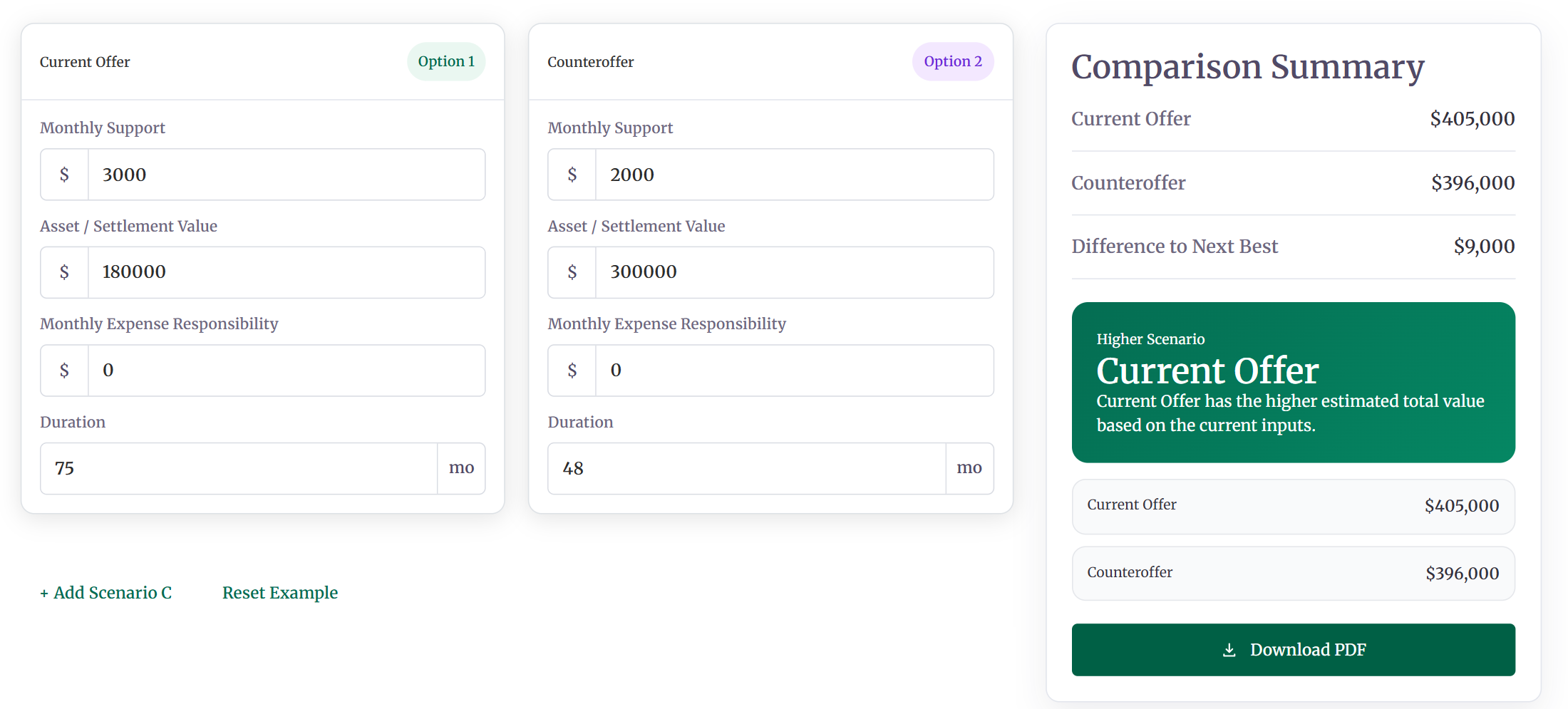
Professionals compare settlement scenarios side by side in SecureSplit®, using tax figures they enter themselves.
SecureSplit® does not calculate income tax yet, and it doesn’t decide whether alimony is deductible. The licensed professional enters the tax figures. See SecureSplit® for financial professionals or SecureSplit® for family law attorneys.
Frequently Asked Questions
I got divorced in December 2019. Can I deduct alimony?
No. Alimony paid under a divorce or separation instrument executed after December 31, 2018, isn’t deductible by the payer or taxable to the recipient on the federal return. If a written separation agreement or temporary order was signed earlier, ask a tax professional which instrument controls.
Does changing a pre-2019 alimony order make it non-deductible?
Not by itself. A modification made after 2018 moves the agreement to the new rules only if it expressly says the new rules apply. The modified payments must still meet the old alimony requirements.
Is a lump-sum alimony buyout tax deductible?
Under a post-2018 instrument, no. Under a pre-2019 instrument it can be, but only if the payment still meets the old alimony requirements, including ending at the recipient’s death. Recapture can also apply, so get a tax professional’s review first.
Is spousal support taxable in California?
It depends on the date of the order or agreement. For California returns, support under instruments executed before January 1, 2026, is generally deductible by the payer and taxable to the recipient, while instruments executed on or after that date follow the federal rule.
Will alimony ever be tax deductible again?
Only if Congress changes the law. Section 11051 of the 2017 tax law, which repealed the deduction, has no end date. Other parts of that law were written to expire after 2025, but this one wasn’t.
Is child support tax deductible?
No. Child support is never deductible and isn’t income to the recipient. Partial payments count as child support first.
Next Steps
The instrument’s execution date sets the federal rule, and a later modification changes it only if the document expressly says so. Because that moves real dollars between spouses, settle the after-tax result before anyone signs.
Tax rules change. This article is general information and isn’t tax or legal advice, so confirm current IRS and state rules before you act on it.
SecureSplit® gives CDFA® professionals one place to model after-tax cash flow, support and property division side by side. See how SecureSplit® works for financial professionals, or book a demo.