TL;DR
- SecureSplit® now has state-specific spousal support and child support calculators in all 50 states, as of the October 20, 2026 release.
- The same release added California support calculators, rebuilt California court-ready forms, and a new Scenario Comparison Builder.
- A spousal support calculator applies a state’s formula or guideline to both spouses’ incomes. The same scenario can produce a different number in every state.
- A calculator gives you a starting point. The judge still decides, and long-term support often turns on factors no formula captures.
SecureSplit® now runs state-specific spousal support calculations in all 50 states. If your practice crosses state lines, or your clients do, you no longer need a different court calculator, spreadsheet, or rule of thumb for each one.
That matters because no two states calculate support the same way. Illinois starts from net income and caps the result. Massachusetts looks at gross income. Texas has no formula at all, just a ceiling. Run the same scenario through three states and you get three different numbers.
This guide covers what shipped, how a spousal support calculator works, why results swing from state to state, and what a calculator can’t decide for you.

What’s New: State-Specific Calculators in All 50 States
The October 20, 2026 release finished SecureSplit®’s state-by-state calculator build. Every state now has its own child support and spousal support calculator, built on that state’s guidelines. The release includes:
- All 50 states. Fifteen more states went live in this release, including New York, Colorado, Virginia, Tennessee and Wisconsin, which completed the map.
- California calculators and forms. California child support and spousal support calculators are live, and California court-ready forms were rebuilt on the new architecture.
- Scenario Comparison Builder. Model two or three settlement options side by side, available to every professional.
- Division of Property export. The property division summary now exports to Excel.
The calculators pull from the case data you’ve already entered, so incomes and expenses don’t get typed twice. The full list is in the October 20, 2026 release notes.
Quick Win: Already a customer? It’s live in your account now. Open any case, go to Case Tools, and choose Spousal Support. The calculator already knows the state from the case’s intake and facts, so there’s nothing to set.
What Is a Spousal Support Calculator?
A spousal support calculator applies a state’s support formula or guideline to both spouses’ income and estimates a monthly payment. The result is a starting point for negotiation or a court hearing. It isn’t an order.
Spousal support calculator: A tool that applies one state’s spousal support formula or advisory guideline to both spouses’ incomes to estimate a monthly payment and, in some states, how long it lasts.
States fall into three rough groups:
- Formula or guideline states publish a percentage formula the court starts from, such as Illinois and New York.
- Advisory guideline states publish a formula the judge can treat as a reference point, such as Colorado.
- Discretion states have no formula, so the judge weighs statutory factors and sets the amount. Texas works this way, with a statutory cap.
The names change too. California says spousal support. Illinois and Arizona say maintenance. Florida and Massachusetts say alimony. They all mean the same thing.
Why the Same Couple Gets Different Numbers in Different States
The same couple gets different numbers in different states because each state uses its own percentages, its own definition of income, and its own caps. Some formulas start from gross income and some from net. Some apply only while the case is pending, and some have an income ceiling above which the formula stops applying.
| State | Approach | How the amount is set | Key limit |
|---|---|---|---|
| California (temporary) | County guidelines | Some counties publish their own guideline. Elsewhere, 40% of the higher earner’s net monthly income minus 50% of the lower earner’s is the common rule of thumb | A guide only; long-term support goes through Family Code §4320 factors |
| Illinois | Statutory guideline | 33⅓% of the payer’s net income minus 25% of the recipient’s net income | Recipient’s total can’t exceed 40% of combined net; applies under $500,000 combined gross |
| New York (post-divorce) | Statutory guideline | Lower of 30% of payer income minus 20% of payee income, or 40% of combined income minus payee income | Payer income counted up to $241,000 |
| Colorado | Advisory guideline | 40% of combined monthly adjusted gross income minus the lower earner’s, then reduced to 80% or 75% | Marriages of 3+ years; combined income up to $240,000 a year |
| Massachusetts | Statutory guideline | Generally no more than the recipient’s need or 30% to 35% of the gross income difference | Income used for child support isn’t counted |
| Florida (durational) | Statutory cap | Lesser of reasonable need or 35% of the net income difference | Recipient must prove need and the payer’s ability to pay |
| Texas | Discretion with a cap | No formula; the court decides | Lesser of $5,000 or 20% of the payer’s gross monthly income |
| Arizona | Statewide guidelines | Arizona Spousal Maintenance Guidelines, revised version effective September 1, 2025 | Court-published calculator for statewide use |
Sources: California Courts, 750 ILCS 5/504, NY Courts guideline notice, C.R.S. 14-10-114, Mass.gov, Fla. Stat. 61.08, TexasLawHelp, Arizona Judicial Branch.
Put real numbers on it. Take one couple: the higher earner nets $12,000 a month and the lower earner nets $3,000.
- California’s common rule of thumb: 40% of $12,000 is $4,800, minus 50% of $3,000 ($1,500), gives $3,300 a month.
- Florida’s durational cap: 35% of the $9,000 difference is $3,150, and the award can’t be more than the recipient’s reasonable need.
- Illinois: the formula gives $3,250, but the 40% cap holds the recipient to $6,000 total, so the guideline is $3,000.
Three states, three numbers, from identical paychecks. And that’s before deductions, child support, or judge’s discretion enter the picture.
Key Insight: The rules of thumb people trade online (“a third of the difference,” “a month for every three years married”) are usually one state’s formula applied in the wrong state. When a client shows up with a number from a forum, the first question is which state it came from.
When a client says a calculator gave them a “wild” number, the cause is usually one of three things: gross income entered where the formula wants net, a temporary formula used to estimate long-term support, or a cap the calculator ignored.
How a Calculation Works in SecureSplit®
In SecureSplit®, the spousal support calculator sits inside the case file. The incomes and expenses from client intake are already there, the calculator applies the state’s guideline, and the result shows both sides of the math. The example below is a California sample case with made-up names and numbers.
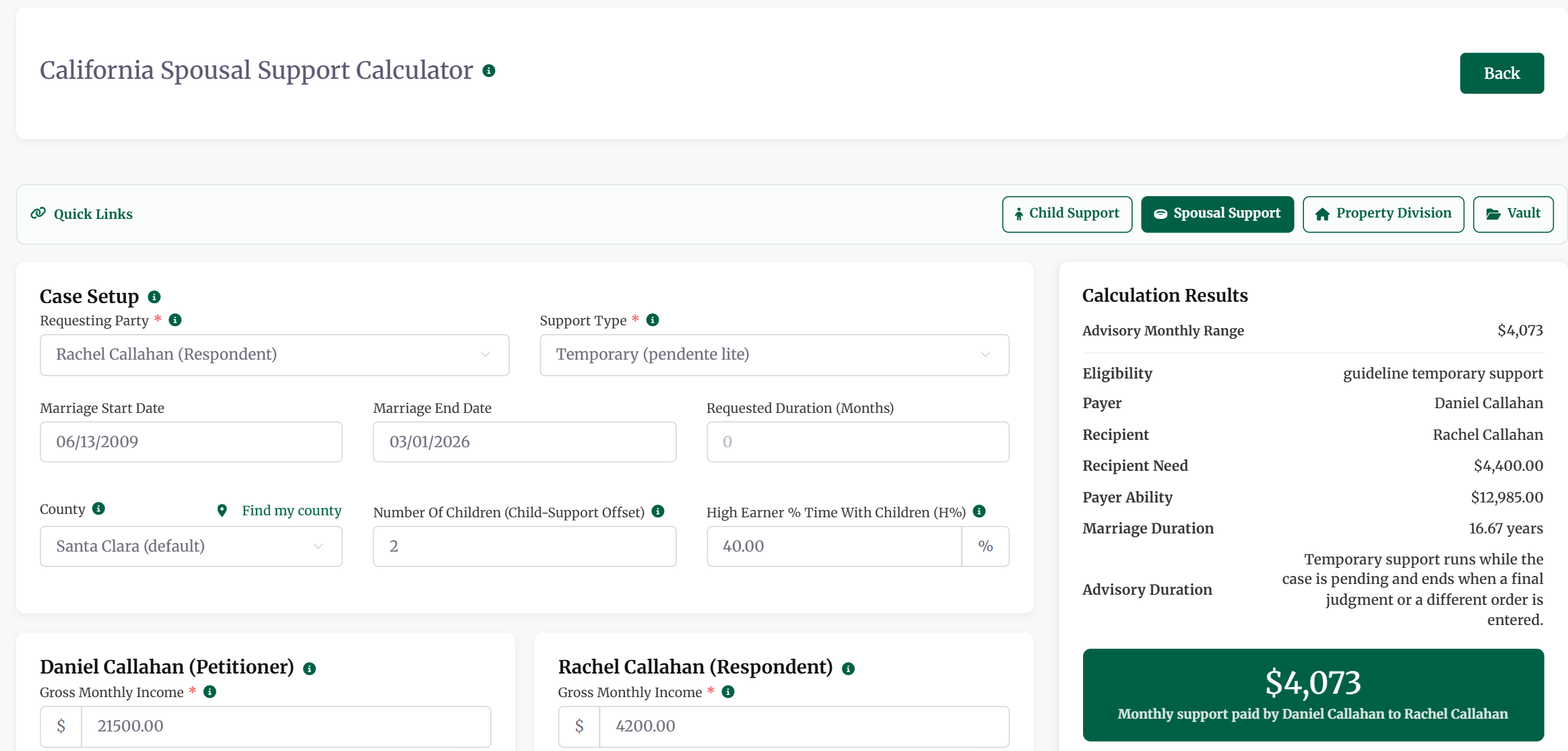
- Open the case. Go to Case Tools and choose Spousal Support. The calculator opens with the state for that case.
- Check the incomes. Gross monthly income for each spouse comes in from intake. In this case, Daniel earns $21,500 a month and Rachel earns $4,200.
- Set up the case. Choose who is requesting support and the support type. In California, that’s temporary (while the case is pending) or long-term under Family Code §4320. California calculations also account for the county, since several counties set their own guideline. SecureSplit® includes county guidelines for Alameda, Kings, Marin, Santa Clara and Yolo.
- Enter deductions and expenses. The calculator lists the guideline deductions under Family Code §4059, including taxes, FICA, union dues, mandatory retirement and health insurance. You enter the verified figures. SecureSplit® doesn’t compute tax.
- Calculate. The results panel shows who pays, who receives, the recipient’s need, the payer’s ability to pay, the length of the marriage, and the monthly amount. Here it’s $4,073 a month in temporary support, against a need of $4,400 and an ability to pay of $12,985.
The same tool works in every state, but the inputs follow each state’s law. In an Illinois case, the calculator asks for net monthly income instead of gross, plus eligibility findings such as whether the payer has prior support obligations.
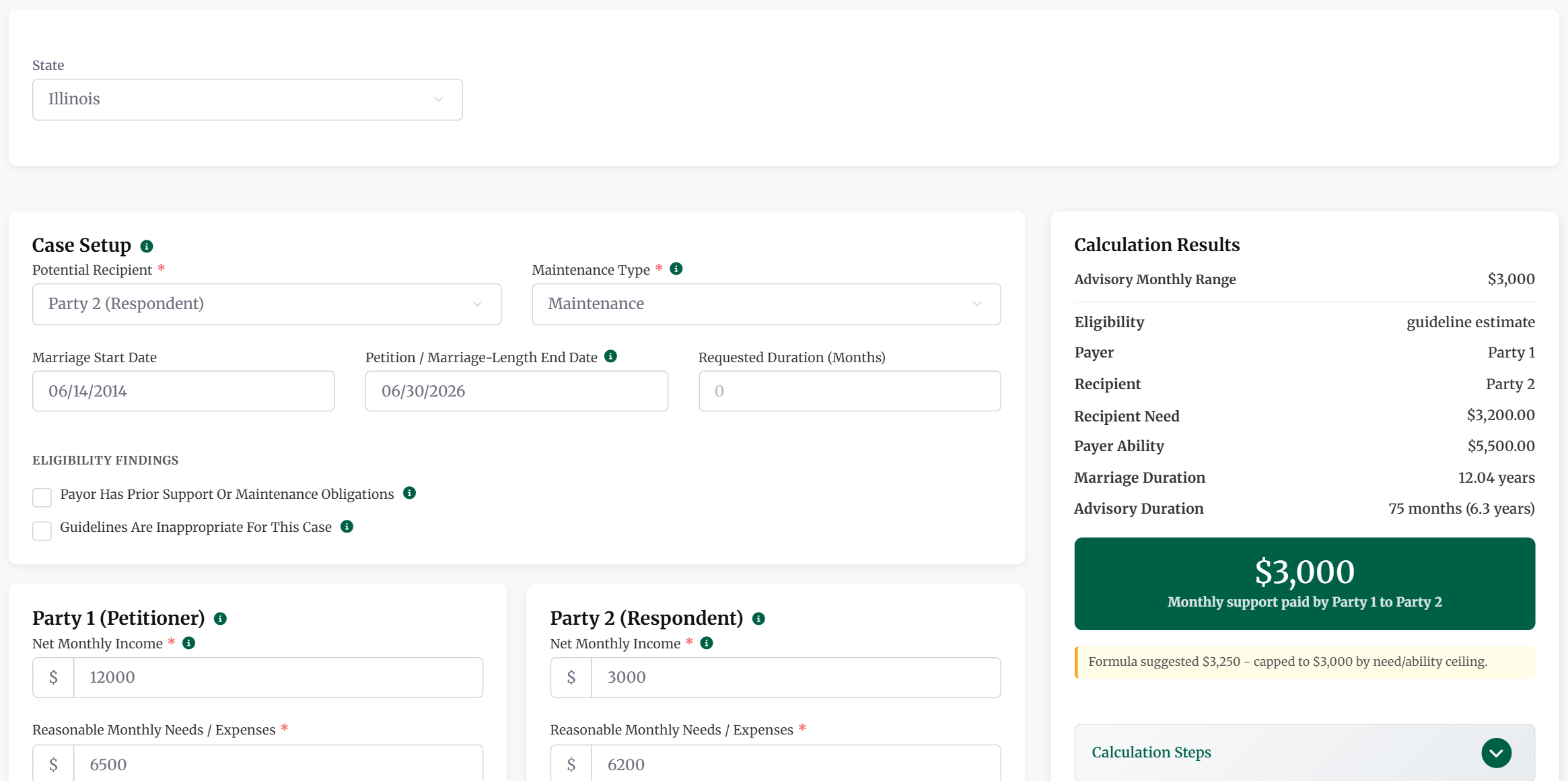
That’s the Illinois couple from the example above. The formula suggests $3,250. The calculator applies the 40% cap, shows $3,000, and tells you it was capped. For a 12-year marriage it also gives an advisory duration of 75 months, which matches the Illinois multiplier of .52 for marriages of 12 to 13 years.
Watch Out: California’s temporary guidelines apply only while the case is pending. Long-term support goes through the factors listed in Family Code §4320, which California’s Form FL-349 walks through. Don’t use a temporary number as a long-term estimate.
Run your next case in any of the 50 states. Start a 7-day free trial.
Free Online Calculator vs. a Professional Calculator
A free online calculator gives one estimate, for one state, for one set of numbers. A professional calculator ties that estimate to the case. It uses the same intake data as the rest of the file, shows both spouses’ positions, and lets you compare settlement options before anyone sits down at the table.
| Free online calculator | SecureSplit® | |
|---|---|---|
| States covered | One state per tool | All 50, set by the case’s state |
| Where the numbers come from | Typed in each time | Pulled from the case intake |
| What the result shows | A monthly estimate | The amount, plus need, ability to pay and duration where the state sets one |
| Child support in the same case | Separate tool, if any | Child support calculator in the same case |
| Comparing settlement options | Not part of the tool | Scenario Comparison Builder |
| Sharing with the client | Screenshot or printout | Secure client portal with uploads and chat |
One complaint shows up again and again in divorce forums: people can’t find a calculator that handles child support and alimony together. In SecureSplit®, both calculators sit in the same case, run on the same intake data, and use the same state.
The Scenario Comparison Builder takes the next step. Put the current offer, the counteroffer and your recommended option side by side. The builder totals each one as settlement value plus monthly support times duration, minus expense responsibility.
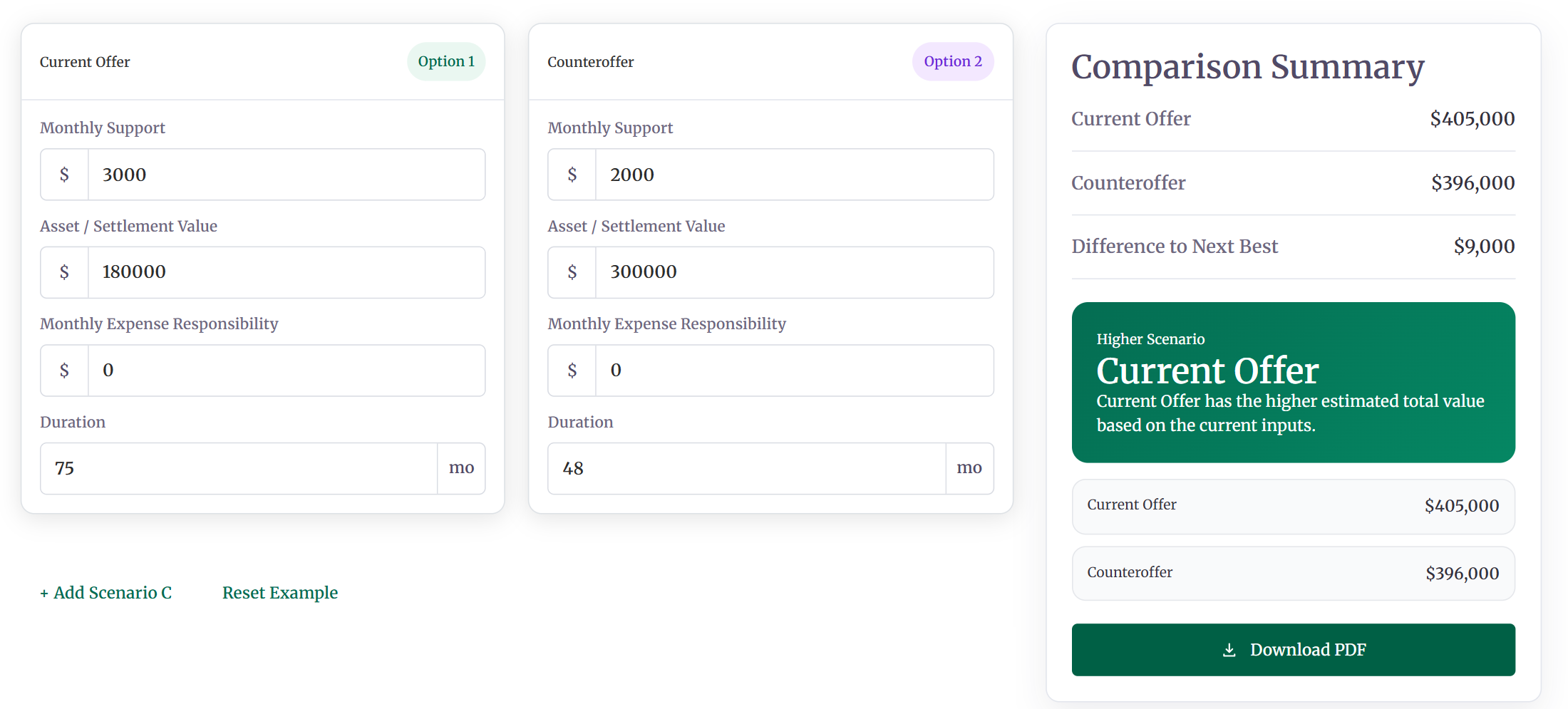
In this example, the current offer pays $3,000 a month for 75 months plus a $180,000 settlement, a total of $405,000. The counteroffer pays $2,000 a month for 48 months plus $300,000, a total of $396,000. The gap is $9,000. That’s a far more useful conversation than “take the higher monthly number.” For more on this approach, see our guide to scenario modeling.
Pro Tip: Run both spouses’ positions before mediation, not during it. A party who sees the other side’s number for the first time at the table tends to dig in. A party who saw the range a week earlier is more likely to negotiate.
What a Spousal Support Calculator Can’t Decide
A calculator applies a formula. It can’t decide whether the formula should apply, and judges can depart from guidelines with findings. Income limits, caps and eligibility rules also push many cases outside the formula entirely.
Four places where that happens:
- Income ceilings. Illinois guidelines apply only when combined gross income is under $500,000. Colorado’s advisory guideline covers combined income up to $240,000 a year.
- Eligibility. Texas generally requires a marriage of 10 years or more before maintenance is available, with some exceptions.
- Burden of proof. In Florida, the spouse asking for alimony must prove both need and the other spouse’s ability to pay.
- Factors. Long-term support in many states rests on factors like earning capacity, health and the standard of living. Our guide to the factors courts weigh covers them, and duration rules are in our guide to how long alimony lasts.
Watch Out: For divorce or separation agreements executed after 2018, alimony isn’t deductible for the payer and isn’t income for the recipient, according to IRS Topic 452. SecureSplit® doesn’t compute tax. The professional enters verified tax figures, and the calculator works from those.
Frequently Asked Questions
Why do two spousal support calculators give different numbers?
Usually because they use different inputs or formulas. One may start from gross income and the other from net. One may be a temporary formula while the other estimates long-term support. Or one applies a cap the other ignores. Check which state’s formula each calculator uses and whether it wants gross or net income.
Can one spousal support calculator work for every state?
Only if it’s built state by state. Each state sets its own formula, income definition and caps, and some states have no formula at all. SecureSplit® now has a separate, state-specific spousal support calculator for each of the 50 states, and the case’s intake and facts determine which one applies.
Is there a calculator that handles child support and spousal support together?
Most free calculators handle one or the other. In SecureSplit®, the child support and spousal support calculators sit in the same case and use the same intake data. Some state formulas also account for child support when figuring spousal support, such as New York’s lower percentages when the payer also pays child support.
Will the judge order the amount the calculator shows?
Not necessarily. Guideline amounts are a starting point, and judges can order a different amount, usually with written findings. California’s court self-help site calls its temporary formulas “just guides.” Spouses can also agree to a different amount in a settlement.
Does a spousal support calculator use gross or net income?
It depends on the state. Illinois, Florida and California’s common temporary formula use net income. Massachusetts compares gross incomes, and Colorado starts from adjusted gross income. Entering the wrong one is the fastest way to a wrong estimate.
Is spousal support taxable?
For agreements executed after 2018, no. Under federal tax law, alimony isn’t deductible for the payer and isn’t taxable income for the recipient, according to IRS Topic 452. Agreements executed before 2019 generally keep the old rules, unless a later modification expressly adopts the new ones. Spouses looking for a quick personal estimate can try our free child support and alimony estimator.
Run Your Next Case in Any State
State-specific spousal support and child support calculators are now live in all 50 states. They sit alongside California’s rebuilt court-ready forms and the new Scenario Comparison Builder. Every calculator pulls from the case you’ve already built, so the numbers in your support estimate match the numbers in the rest of the file.
Start a 7-day free trial or book a 30-minute demo to see a case run in your state. Built for family law attorneys, paralegals and mediators, as well as CDFA® professionals.