TL;DR
- Financial planning for divorce turns a couple’s finances into settlement options a client can understand and choose between.
- CDFAs run it in seven phases: Develop, Intake, Validate, Organize, Run analysis, Communicate, and Execute.
- Most errors start in the first three phases, long before any numbers get modeled.
- Check the federal rules on alimony, retirement splits, and transfers between spouses before the settlement is signed.
- A process you repeat on every case is what lets one planner take on more cases without missing steps.
Search for financial planning for divorce and you’ll find checklists from big banks telling a spouse which statements to pull. That’s useful for the client. It doesn’t help the planner sitting across the table, who has to turn those statements into numbers an attorney can negotiate with.
This guide covers the planner’s side. It walks through a seven-phase process, with what each phase involves, the data it needs, and what it should produce before you move on. The phases come from the DIVORCE Framework, built by SecureSplit co-founder Jamie Lima, CFP®, CDFA®.

What Is Financial Planning for Divorce?
Financial planning for divorce is the work of gathering a couple’s full financial picture, checking it, and modeling settlement options so a client can see how each one plays out over the years ahead. It runs alongside the legal case. The attorney negotiates the terms, and the planner shows what those terms are worth.
Financial planning for divorce: The process of collecting, verifying, and organizing a divorcing couple’s assets, debts, income, and expenses, then modeling division and support options so the client and their attorney can compare outcomes before agreeing to one.
The work is usually led by a certified divorce financial analyst (CDFA®) or a financial advisor with divorce experience. If you’re weighing the designation itself, our guide to what a certified divorce financial analyst does and how to become one covers the credential, the cost, and the exam.
Going It Alone vs. Professional Process
The guides that rank for divorce financial planning tell a spouse what to gather. A professional process covers what happens to that information next: checking it, structuring it, modeling it, and carrying out the final agreement.
| Going it alone | Professional process | |
|---|---|---|
| Starts with | A list of documents to collect | The planner’s role, the scope, and the client’s goals |
| Data quality | Taken as given | Checked against source documents |
| Property | Listed | Sorted into marital, separate, or disputed, then valued |
| Settlement options | One proposal at a time | Two to four options compared together |
| Taxes and retirement | “Talk to a professional” | Checked against IRS and plan rules before signing |
| After the decree | Update your will | Track every transfer, order, and retitled account |
The Seven Phases of Financial Planning for Divorce
The process runs in seven phases, and each one produces something the next phase depends on. Skip one, and the gap shows up later, usually at the worst time.
D: Develop the Client Relationship
The first phase is about trust, role, and scope. As the framework puts it, you “establish trust, clarify role, and set scope before a single document is touched.”
What this phase usually involves:
- Confirming in writing whose side you’re on, or whether both spouses hired you as a neutral
- Setting the fee, the scope of work, and what’s out of scope
- Learning what the client wants most: keeping the house, staying near the kids’ school, protecting retirement, or getting out of shared debt
- Agreeing with the attorney on how you’ll share information and who talks to the other side
Output: a signed engagement agreement and a short written list of the client’s goals.
Pro Tip: Write down the client’s top three goals in their own words at the first meeting. Months later, when the options are on the table, reading those words back helps a stressed client remember what they came in wanting.
I: Intake and Onboarding
Intake is where the client starts handing over records, and the framework’s aim is to “give the client a structure that reduces overwhelm.” Clients in the middle of a divorce are tired and overloaded. A long email asking for “all your financial documents” usually gets a partial answer.
What this phase usually involves:
- Sending one structured request with every document listed, a deadline, and the format you want
- Using a secure portal for uploads so account numbers don’t travel by email
- Scheduling a short check-in a week later to see what’s stuck
Data needed: see the master checklist further down.
Output: a document inventory showing what’s in, what’s missing, and who is chasing each missing item.
V: Validate Data
Validation is where you confirm accuracy, find gaps, and, in the framework’s words, “eliminate garbage-in before analysis begins.” It’s the least visible phase to the client and the one that protects everything after it.
What this phase usually involves:
- Matching every balance to a statement and noting the statement date
- Tying the income on pay stubs to the income on the tax returns
- Reading the tax returns for clues: interest or dividends from an account that never appeared in the disclosure, or business income with no business records attached
- Sending a written list of gaps to the attorney, who decides how to pursue them
For more on this step, see our post on turning financial disclosure into insight.
Output: a reconciled data set and a gaps list for the attorney.
Watch Out: The tax return is the best cross-check you have. A dividend on Schedule B with no matching brokerage statement means an account is missing from the disclosure, whether by accident or not.
O: Organize the Financial Picture
This phase turns a pile of documents into “decision-ready structure,” using the same core tables on every case. When your tables look the same every time, you spot what’s unusual faster, and so does the client.
What this phase usually involves:
- Building a marital balance sheet with every asset and debt in one place
- Tagging each item as marital, separate, or disputed (the attorney decides the disputed ones)
- Drafting a monthly budget for each household after the divorce
- Laying out a timeline of key dates: marriage, separation, account openings, and vesting dates for any stock awards
Our post on why strong divorce strategies start with financial organization goes further on this phase.
Output: a balance sheet, two household budgets, and a timeline, in the same format as every other case you run.
R: Run Analysis and Model Scenarios
Here the work is to “convert the financial picture into 2 to 4 comparable settlement options.” Each option should show property division, support, and each household’s cash flow over time, and every asset should be counted at its after-tax value.
What this phase usually involves:
- Calculating property division and any equalization payment
- Running child and spousal support figures under the state’s guidelines
- Valuing retirement accounts and pensions, and working out how each would be split
- Projecting each household’s cash flow over several years for every option
Key Insight: Most settlement decisions come down to trade-offs between options that are close in total value. Two to four clear options give the client something concrete to decide on.
The tax side matters most when one spouse proposes a trade, such as more property in exchange for less alimony. For divorce or separation instruments executed after 2018, alimony “won’t be deductible by the payer” and “won’t be includible in the income of the recipient,” according to IRS Publication 504. A dollar of alimony and a dollar from a 401(k) aren’t the same to the person receiving them, because the 401(k) dollar is generally taxed as income when it’s withdrawn. Model both, after tax, before the client agrees to the trade. Our post on divorce scenario modeling covers how to lay the options out.
Output: two to four settlement options, each with the same set of numbers.
C: Communicate Findings
The analysis only helps if the client and attorney can use it, so this phase is about making it “usable in a real negotiation room” and translating “numbers into decisions.”
What this phase usually involves:
- Walking the client through each option against the goals they named in the first phase
- Explaining terms like equalization and present value in plain words, with the client’s own numbers
- Briefing the attorney before any negotiation session, so they aren’t seeing your numbers for the first time in the room
- Updating the options quickly when the other side counters
Our post on what clients hear vs. what professionals mean covers the language side of this phase.
Output: a report the attorney can take into negotiation, and a client who can explain why they chose the option they chose.
E: Execute and Implement
The last phase exists to “prevent great settlements from failing in implementation.” An agreement that splits a retirement account or retitles a house does nothing until someone completes each step.
What this phase usually involves:
- Listing every transfer, retitling, and account closing the agreement calls for, with an owner and a date for each
- Making sure any qualified domestic relations order (QDRO) is drafted, accepted by the plan, and acted on
- Prompting the client to update beneficiaries on retirement accounts and life insurance
- Building the client’s first post-divorce budget and longer-term plan
For why this phase matters years later, read why the same divorce settlement can look different five years later.
Output: an implementation tracker with an owner and a due date on every item.
Watch Out: A settlement that splits a 401(k) does nothing until a QDRO is drafted and the plan accepts it. Put the QDRO on the tracker with a date, and confirm the plan’s acceptance in writing.
Divorce Financial Planning Checklist: The Documents to Request
Most cases need the same core documents. Asking for all of them in one request at intake saves weeks of follow-up. The last three years of tax returns is a common starting point, though complex cases may need more.
| Document | Why it matters | Phase |
|---|---|---|
| Last 3 years of tax returns, with all schedules | Shows every income source and points to accounts that may be missing | Intake, Validate |
| Recent pay stubs and W-2s or 1099s | Confirms current income for support figures | Intake, Validate |
| Bank and brokerage statements | Balances, cash flow, and transfers between accounts | Intake, Validate |
| Retirement plan statements and plan documents | Balances, vesting, and what the plan allows when it’s split | Organize, Run analysis |
| Pension benefit statements | Needed to value a pension | Run analysis |
| Mortgage statements and a home value estimate | Equity in the marital home | Organize, Run analysis |
| Loan and credit card statements | Every debt that has to be divided | Organize |
| Stock option and RSU grants, with vesting schedules | Often missed, and hard to value without the grant terms | Organize, Run analysis |
| Business tax returns and financial statements | Needed if either spouse owns a business | Organize, Run analysis |
| Life, health, and disability insurance policies | Coverage after divorce, and security for support | Execute |
| Prenuptial or postnuptial agreements | May change what counts as marital property | Develop, Organize |
| Social Security statements | Benefit estimates, including a possible ex-spouse benefit | Run analysis |
Rules to Check Before the Settlement Is Signed
A handful of federal rules decide what a settlement is actually worth. Check them while you model options, then check them again before signing.
| Rule | What to check | Source |
|---|---|---|
| Alimony taxes | Under instruments executed after 2018, alimony isn’t deductible for the payer or taxable to the recipient. Older instruments keep the old treatment unless a modification expressly says otherwise. | IRS Publication 504 |
| Filing status | A client counts as unmarried for the whole year only with a final decree by the last day of the tax year. An interlocutory decree isn’t a final decree. | IRS Publication 504 |
| Transfers between spouses | A transfer is “incident to divorce” if it happens within 1 year after the marriage ends, or is made under the divorce instrument within 6 years. | IRS Publication 504 |
| Retirement splits | The exception to the 10% early-withdrawal tax for payments under a QDRO applies to qualified plans like 401(k)s. It does not apply to IRAs. | IRS early-distribution exceptions |
| What a QDRO must include | Names and last known mailing addresses of the participant and each alternate payee, the name of each plan, the amount or percentage (or how to calculate it), and the number of payments or time period | U.S. Department of Labor |
| Ex-spouse Social Security | An ex-spouse married at least 10 years may be eligible for benefits of up to half the worker’s benefit amount | Social Security Administration |
Confirm how these rules apply to each case with the client’s attorney and tax professional.
Where Software Fits in the Process
Software helps most in the phases that repeat the same work on every case: intake, organizing, modeling, and reporting. Developing the relationship, validating the data, and explaining the results still come down to the planner’s judgment.
| Phase | Where a divorce financial platform helps |
|---|---|
| Intake | A secure portal where the client uploads documents and enters financial information once |
| Organize | The same core tables on every case, built from the data already entered |
| Run analysis | Support and property division calculations tied to versioned rule sets, plus pension and RSU calculators |
| Run analysis | Settlement scenarios compared side by side, with cash flow for each household |
| Communicate | Client-facing reports built from the same numbers the planner modeled |
| All phases | An audit trail that shows how each number was reached if it’s questioned |
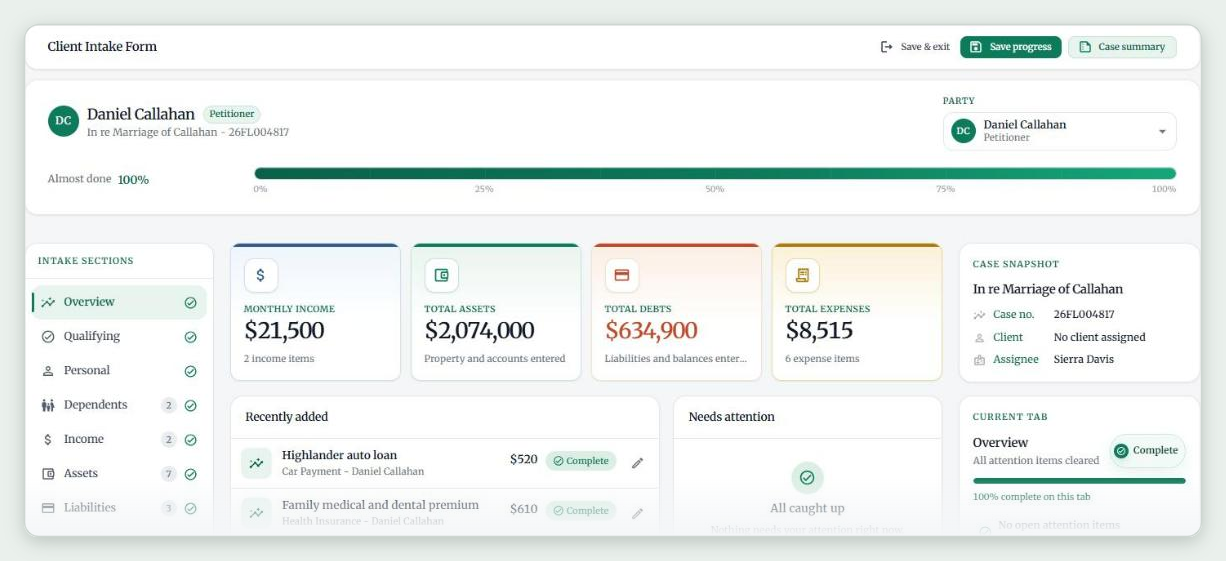
SecureSplit was built by a CDFA® to run this whole process in one place, and it’s a trusted IDFA® software provider. Our page on SecureSplit for financial professionals shows each step, and our post on why spreadsheets fall short in divorce financial planning covers what changes when you move off them.
Frequently Asked Questions
What documents do you need for divorce financial planning?
Most cases start with the last three years of tax returns, recent pay stubs, bank and brokerage statements, retirement and pension statements, and mortgage and loan statements. Stock compensation records, business financials, and insurance policies are needed when they apply. Collecting everything in one request at intake saves weeks of follow-up.
What is the first step in divorce financial planning?
The first step is setting the scope: what role the planner plays, what the client’s goals are, and how the planner will work with the attorney. Document gathering comes next, once everyone knows what the work covers. Skipping this step is how scope creep and fee disputes start.
What is a marital balance sheet?
A marital balance sheet lists every asset and debt a couple has in one place, with values, owners, and whether each item is marital, separate, or disputed. It’s the base for every settlement option the planner models. Keeping it in the same format on every case makes gaps easier to spot.
Is alimony taxable?
For divorce or separation instruments executed after 2018, alimony isn’t deductible for the payer and isn’t taxable income for the recipient, according to IRS Publication 504. Older instruments follow the earlier rules unless a later modification expressly adopts the new treatment. This changes how alimony compares with a larger share of pre-tax retirement money.
Can you avoid the 10% penalty when splitting a 401(k) in divorce?
Payments to a former spouse under a qualified domestic relations order (QDRO) are exempt from the 10% early-withdrawal tax for qualified plans like 401(k)s, according to the IRS. The exception does not apply to IRAs, which are divided under different rules. Regular income tax generally still applies to the money withdrawn.
How do you compare divorce settlement options?
Model two to four options with the same set of numbers, including each household’s cash flow over time and the after-tax value of what each spouse receives. Tie each option back to the client’s stated goals so the client can weigh the trade-offs in each one. Update the options quickly when the other side counters.
Next Steps
The seven phases stay the same from case to case, and that sameness is what lets a planner take on more cases without dropping steps.
When you’re ready to run cases on one platform, IDFA® members get 25% off the first year of SecureSplit. You can also book a 30-minute demo.