TL;DR
- Filing status is set on December 31. A final decree by then means the client is unmarried for the whole year.
- Transfers between spouses, or to a former spouse incident to the divorce, generally trigger no gain or loss. The recipient keeps the old basis, so tax shows up at sale.
- A QDRO payout from a 401(k) or pension to a former spouse avoids the 10% additional tax. IRA distributions don’t get that exception.
- Alimony treatment turns on when the agreement was executed: before 2019 or after 2018.
- Each ex-spouse can exclude up to $250,000 of home-sale gain if they meet the ownership and use tests.
- General information only. Confirm current IRS guidance.
Divorce tax implications are where a settlement that looks even on paper can land unevenly once the tax bills arrive. Most of that risk is written into the settlement itself, so it has to be caught before anyone signs. This guide gives you a checklist by issue and asset type to run against every draft, which is a big part of what a Certified Divorce Financial Analyst® does.
This is general information, not tax or legal advice. Confirm current IRS guidance and have a licensed tax professional review the client’s facts.

What Are Divorce Tax Implications?
Divorce tax implications are the federal income tax effects of ending a marriage: the client’s filing status, who claims the children, how support is taxed, and the tax that comes with each asset when it’s sold or withdrawn. Most of them are fixed by choices made in the settlement, which is why the review belongs before signing.
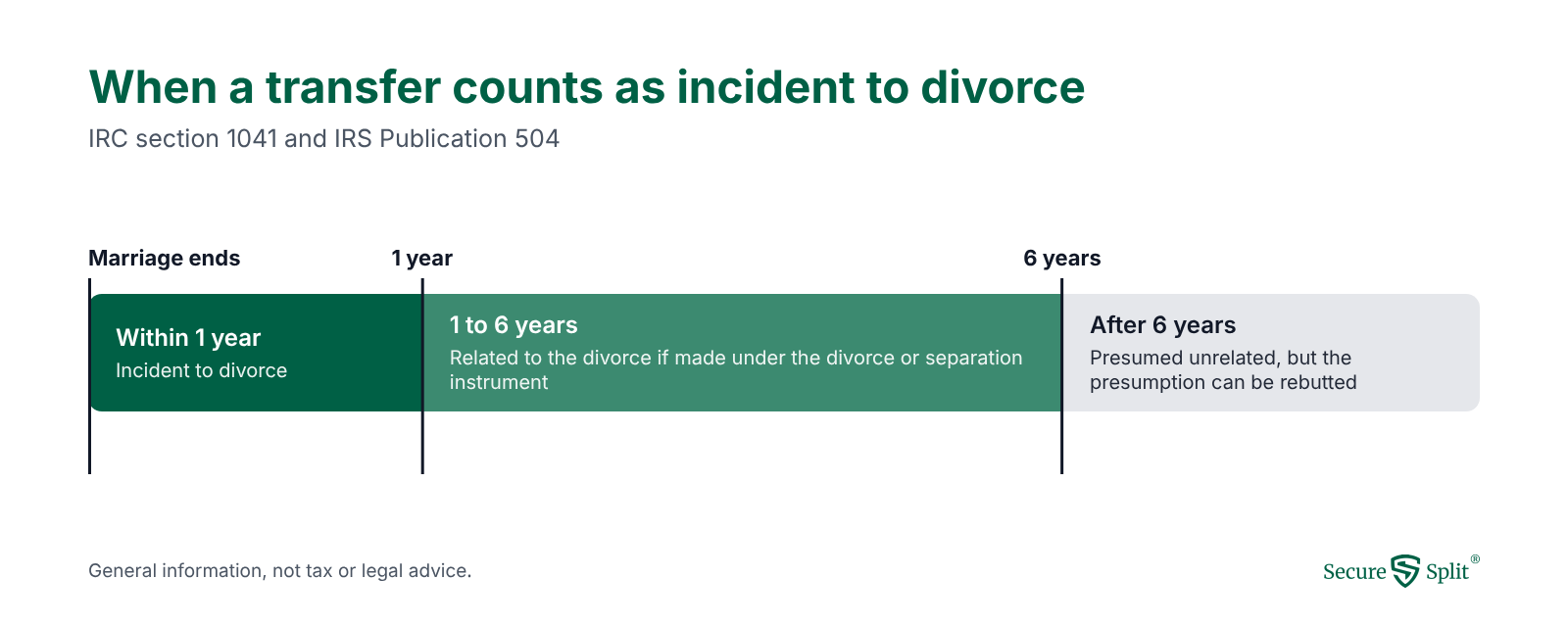
Transfer incident to divorce: A transfer of property to a former spouse that happens within 1 year after the marriage ends, or that is related to the end of the marriage. Under IRC section 1041, no gain or loss is recognized on it, and the person who receives the property takes over the transferor’s adjusted basis.
The Pre-Signing Divorce Tax Checklist
Run this list against every draft settlement. Each row names the issue, the federal rule that controls it, and what to put in the case file before the client signs.
| Issue / asset | What to check before signing | The federal rule | What to model in the file |
|---|---|---|---|
| Filing status | Will the decree be final by December 31? | Marital status on the last day of the tax year sets status for the year | Year-of-divorce return options for each spouse |
| Head of household | Who pays more than half the cost of the home, and where does each child live more than half the year? | HOH needs a qualifying person and more than half the upkeep | Which parent qualifies, child by child |
| Dependents and Form 8332 | Does the agreement say who claims each child, for which years, and require a signed Form 8332? | The custodial parent has more nights; release via Form 8332 or a similar statement | Child credits by year for each parent |
| Alimony | When was the instrument executed, and has a pre-2019 agreement been modified? | After 2018: not deductible, not income. Before 2019: generally deductible and taxable | Support as pre-tax or after-tax cash flow |
| Brokerage, real estate, business interests | What is the adjusted basis of each asset? | IRC 1041: no gain or loss on transfer; recipient takes transferor’s basis | Built-in gain on each asset offered |
| 401(k) and pensions | Is there a QDRO, and does the receiving spouse need cash before age 59½? | QDRO payouts to a spouse or former spouse are taxed to them; the 10% exception applies for qualified plans | Cash needed now vs. amount rolled over |
| IRAs | Is the split written into the decree or an instrument incident to it? | Transfer under the decree isn’t taxable; the account becomes the recipient’s IRA | IRA share as pre-tax dollars |
| Marital home | Who will sell, when, and can each spouse meet the 2-of-5-year tests? | Up to $250,000 exclusion per individual ($500,000 joint) | Gain above the exclusion, per spouse |
| Ex living in the home | Does the decree grant the occupying spouse use of the home? | Owner is treated as using the home while the ex has use under the instrument | Exclusion still available to the owner who moved out |
| Prior joint returns | Are past returns filed and paid? Any audit risk? | Both spouses stay liable on joint returns filed before the divorce | Indemnity language; Form 8857 relief if needed |
| Refunds and estimated payments | How will a pending joint refund and joint estimated payments be split? | Joint estimated payments can be divided any way the spouses agree | Allocation written into the agreement |
| Nonresident alien spouse | Is either spouse a nonresident alien? | IRC 1041(a) does not apply | Flag for tax counsel |
Download the Pre-Signing Divorce Tax Checklist (PDF).
1. Filing Status and the December 31 Rule
The client’s filing status for the whole year depends on their marital status on December 31. If the final decree of divorce or separate maintenance is in place by the last day of the tax year, the IRS treats the client as unmarried for the entire year. If the decree comes later, the spouses are still married for that year and choose between filing jointly and filing separately.
When the decree date falls close to year end, model both outcomes. A joint return lowers the tax for many couples but leaves both spouses liable for the full amount (see section 7). After the divorce, the IRS says withholding usually needs adjusting with a new Form W-4.
Head of household after divorce
Head of household status needs a qualifying person, usually a child who lived with the client more than half the year, and the client must pay more than half the cost of keeping up the home. Rent, mortgage interest, real estate taxes, insurance, repairs, utilities and food eaten in the home all count toward that cost.
Key Insight: There is no “divorced” filing status. A client whose divorce is final by December 31 files as single, or as head of household if they qualify, unless they remarry before the year ends.
2. Dependents and Form 8332
The custodial parent is the parent the child lived with for the greater number of nights during the year. With an exact tie, it’s the parent with the higher adjusted gross income. The custodial parent can release the claim to the other parent with Form 8332 or a similar statement, and the release can cover one year, specific years such as alternate years, or all future years.
The release lets the noncustodial parent claim the child tax credit, the additional child tax credit and the credit for other dependents, and that parent attaches the signed release to their return for each year it applies. Write the years into the agreement child by child, and require the custodial parent to sign Form 8332 for each of them.
Watch Out: Form 8332 does not move head of household status, the earned income credit or the dependent care credit. A decree that says “Dad claims the child in odd years” doesn’t give Dad head of household status in those years.
3. Alimony and the Agreement Date
Alimony paid under a divorce or separation instrument executed after 2018 isn’t deductible by the payer and isn’t income to the recipient at the federal level. States have their own rules. Payments under an instrument executed before 2019 generally stay deductible and taxable, unless a later modification expressly adopts the new rule. Child support is never deductible and is never income.
IRS Topic 452 covers the tax side, and our guide to what alimony is based on covers how the amount is set. For the full rules, see our guide to whether alimony is tax deductible.
4. Property Transfers and Carryover Basis (IRC 1041)
A property settlement between spouses usually isn’t a taxable event. Under IRC section 1041, no gain or loss is recognized on a transfer to a spouse, or to a former spouse if the transfer is incident to the divorce, and the recipient takes the transferor’s adjusted basis. The tax travels with the asset and comes due when whoever ends up owning it sells.
IRS Publication 504 treats a transfer as related to the end of the marriage when it’s made under the divorce or separation instrument within 6 years after the marriage ends. The basis carries over even when it’s above or below the value at transfer, and section 1041 doesn’t apply when the receiving spouse is a nonresident alien.
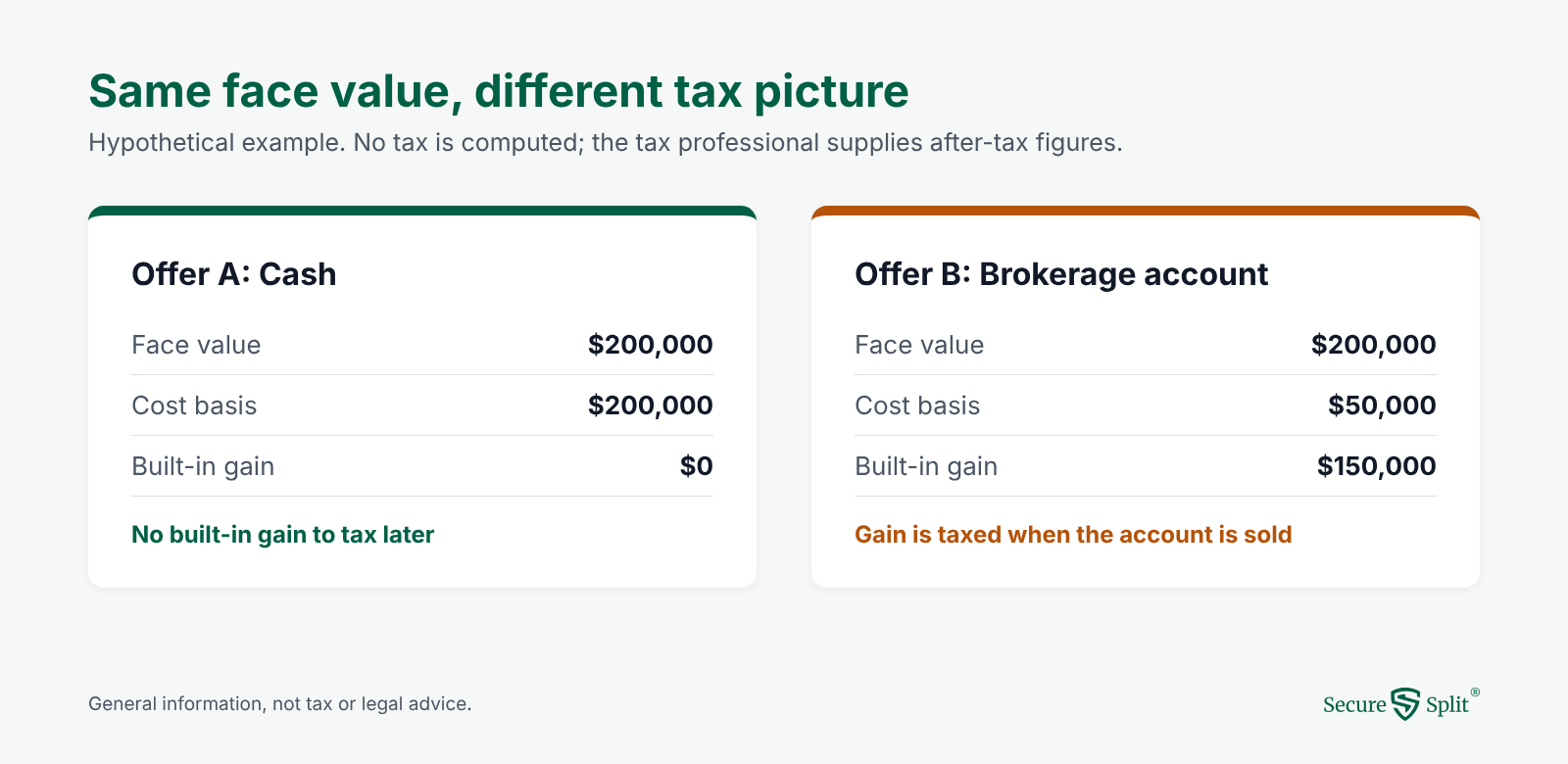
In a hypothetical case, a $200,000 brokerage account with a $50,000 basis carries $150,000 of built-in gain, while $200,000 in cash carries none. Both show the same face value, but only the brokerage account brings a tax bill when it’s sold. See how asset value is measured in divorce for more on this gap.
Pro Tip: Ask for the cost basis of every non-cash asset before you compare offers. An even split of face value can be an uneven split after tax.
SecureSplit® keeps the case file, the property division and the support numbers in one place, and shows pre-tax values alongside each item. See how SecureSplit® works for financial professionals.
5. Retirement Accounts: QDROs, IRAs and the 10% Exception
A 401(k) or pension is split with a qualified domestic relations order (QDRO), and a spouse or former spouse who receives QDRO benefits reports them as if they were the plan participant. Distributions to that alternate payee under a QDRO are exempt from the 10% additional tax on early distributions, but the exception doesn’t apply to IRAs.
| Account | How it’s divided | 10% additional tax exception for the receiving spouse |
|---|---|---|
| 401(k), pension (qualified plan) | QDRO | Yes, for distributions to the alternate payee under the QDRO |
| IRA | Transfer under the decree or a written instrument incident to it | Not available (n/a on the IRS table) |
- The QDRO must name each alternate payee and the amount or percentage to be paid. It can’t award a benefit the plan doesn’t offer.
- A spouse or former spouse can roll a QDRO distribution over tax-free.
- An IRA transfer under the decree isn’t taxable, and from the transfer date the account is the recipient’s IRA.
If the client needs cash from the QDRO share, settle the amount before any rollover as part of post-divorce cash flow planning.
Watch Out: A hardship withdrawal and a QDRO distribution are two different things, and forum threads often mix them up. The 10% exception in IRC section 72(t)(2)(C) covers payments to an alternate payee under a QDRO from a qualified plan, and a hardship withdrawal doesn’t qualify.
6. The Marital Home and the $250,000 Exclusion
A client may exclude up to $250,000 of gain on the sale of a main home, or up to $500,000 on a joint return, if they meet both the ownership test and the use test: at least 24 months each during the 5 years before the sale. After a divorce, each former spouse who meets the tests on their own return can generally claim up to $250,000.
- A client who received the home from a spouse or ex-spouse can count the time the other spouse owned it, but must meet the use test on their own.
- Under IRC 121(d)(3)(B), an owner is treated as using the home while the spouse or former spouse has use of it under a divorce or separation instrument. That protects the spouse who moved out.
- The exclusion generally isn’t available if the client excluded gain on another home in the 2 years before the sale.
Pro Tip: If one spouse will stay in the house for a few years before it’s sold, the grant of use needs to be in the decree or separation agreement. That language is what lets the spouse who moved out count the use period. Drafting it is a job for the family law attorney, so the financial professional’s role is to flag it early. For buyout and sale options, see how a house is divided in divorce.
7. Joint Returns, the Divorce Tax Refund Split and Estimated Payments
Divorce doesn’t end liability on joint returns already filed. Each former spouse stays jointly and individually responsible for the tax, interest and penalties on a joint return for a year before the divorce, even if the decree assigns the debt to the other spouse. The settlement should also say how any pending joint refund and any joint estimated payments will be split.
- Innocent spouse relief, separation of liability relief and equitable relief are requested on Form 8857.
- If the client’s share of a joint refund is applied to the other spouse’s past-due debts, Form 8379 can recover it.
- The IRS pays a joint refund the way the return directs, by paper check or by direct deposit to either spouse’s account or a joint account, so each spouse’s share belongs in the agreement.
- Joint estimated payments can be divided any way both spouses agree. If they can’t agree, Publication 504 gives a formula.
Pull the last few joint returns early, along with the other financial documents to gather before divorce.
Comparing Pre-Tax and After-Tax Offers
Two offers with the same total can leave the client with very different after-tax results. The fix is to put each asset’s pre-tax value next to the after-tax figure the tax professional supplies, and then compare whole scenarios side by side. The table uses hypothetical numbers and computes no tax.
| Offer | Assets | Face value | What to add before comparing |
|---|---|---|---|
| Offer A | $200,000 cash | $200,000 | Nothing; cash has no built-in gain |
| Offer B | $200,000 brokerage account, $50,000 basis | $200,000 | $150,000 built-in gain; tax figure from the tax professional |
| Offer C | $200,000 401(k) share via QDRO | $200,000 | Pre-tax dollars; income tax on withdrawal, figure from the tax professional |
With those figures in, divorce scenario modeling puts each settlement next to the others, and the results feed the CDFA® financial planning process.
Where SecureSplit® Fits
SecureSplit® does not compute income tax yet, and it doesn’t give tax advice. It gives the CDFA® professional or advisor one case file to model property division and support, with pre-tax values shown alongside each item, and to compare scenarios side by side using the tax figures the licensed professional enters. It also includes pension, RSU and scenario comparison calculators. Learn more about SecureSplit® for financial professionals.
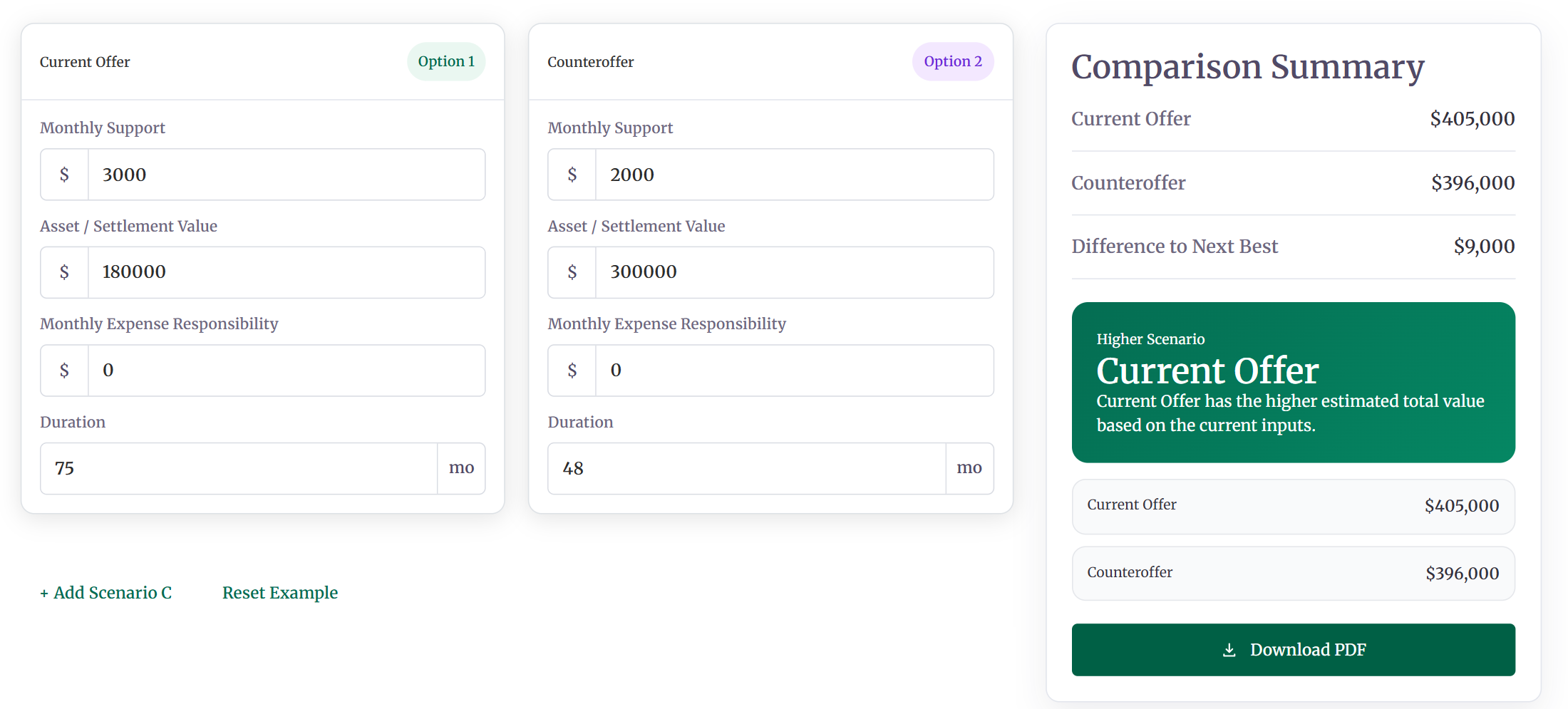
A sample case in SecureSplit®: two offers side by side, built from figures the professional enters.
Frequently Asked Questions
Is a divorce settlement taxable?
Usually not when the settlement transfers property between spouses. Under IRC section 1041, no gain or loss is recognized on a transfer to a spouse, or to a former spouse incident to the divorce, but the recipient takes over the original basis, so tax can come due when the asset is later sold.
How do you split a tax refund after divorce?
The settlement should say how. The IRS pays a joint refund the way the return directs, by paper check or by direct deposit to either spouse’s account or a joint account, so the agreement needs to spell out each spouse’s share.
Can divorced parents alternate years claiming the kids?
Yes, for the child-related credits. The custodial parent can sign Form 8332 releasing the claim for one year, for specific years such as alternate years, or for all future years. The release doesn’t move head of household status, the earned income credit or the dependent care credit.
Can each ex-spouse exclude $250,000 when the house is sold?
Generally yes, if each one meets the ownership and use tests: at least 24 months of each during the 5 years before the sale. A spouse who moved out can still be treated as using the home while the ex lives there under the divorce or separation instrument.
Is a 401(k) hardship withdrawal the same as a QDRO distribution?
No. Distributions to a former spouse under a QDRO from a qualified plan are exempt from the 10% additional tax on early distributions, and a hardship withdrawal doesn’t get that exception.
Is it better to file as divorced or single?
There is no “divorced” filing status. If the decree is final by December 31, the client is unmarried for the whole year and files as single, or as head of household if they qualify.
Catch Tax Issues Before the Client Signs
Run the checklist on every draft settlement while the terms can still change. Keep the numbers in one file, and compare scenarios side by side using the tax figures the licensed professional supplies. See how SecureSplit® works for financial professionals, or book a demo.
This article is general information, not tax or legal advice. Tax rules and IRS publications change every year, so confirm current IRS guidance and have a licensed tax professional review the client’s situation.