TL;DR
- Alimony starts with two questions: does one spouse need support, and can the other spouse pay?
- Courts then weigh factors set in state law: income and earning capacity, marriage length, the lifestyle during the marriage, age and health, contributions, and children.
- Some states use a formula or a hard cap (Massachusetts, Illinois, New York, Colorado, Florida, Texas). Others leave the amount to the judge.
- Every factor needs proof. Tax returns, pay records, a year or more of statements, and a sworn budget carry most of it.
- Rules vary by state. The statute and the supervising attorney decide.
The support request is due next week. The attorney wants the file to show why the number is fair, not just what the number is.
So what is alimony based on? In every state, it comes down to need, ability to pay, and a list of factors written into that state’s law. The factor lists look a lot alike from state to state. What changes is whether a formula sits on top of them, and how much paper a judge expects to see behind each one.
This guide covers all three: the factors, the formulas, and the records that prove each factor. Statutes are quoted as examples only. Your state’s law and the supervising attorney always have the final word.

What Is Alimony Based On?
Alimony is based on one spouse’s need for support and the other spouse’s ability to pay, measured against factors in state law. Those factors usually include income, earning capacity, the length of the marriage, and the lifestyle the couple had while married.
Alimony (also called spousal support or maintenance): Court-ordered support paid by one spouse to the other for a period of time after a divorce, as the Massachusetts Probate and Family Court defines it.
Florida spells out the order of operations better than most. Under Florida Statutes section 61.08, the court first decides whether the person asking has an actual need and whether the other spouse can pay. The person asking carries the burden of proving both. Only then does the court move on to the factor list. Other states set a similar bar: Colorado and Texas allow an award only if the spouse asking lacks enough property or income to meet their own needs.
Key Insight: Qualifying and amount are two separate questions. A spouse can clear the first one and still walk away with a small award. Build the file to answer both.
The Factors Courts Weigh in an Alimony Decision
Courts weigh a set list of financial and personal factors, and most states use some version of the same list. Here is what each one means and where it shows up in real statutes.
Income and earning capacity
Courts look at what each spouse earns now and what each could earn. Illinois lists “the realistic present and future earning capacity of each party” as a factor in 750 ILCS 5/504. Massachusetts goes further and asks whether a spouse could become employable “with reasonable effort and more training.”
That’s why a recent drop in pay doesn’t settle the income question on its own.
Watch Out: A court may treat an able spouse as able to earn, even if that spouse isn’t working now. Massachusetts lets the court attribute income to a spouse who is unemployed or underemployed (G.L. c. 208, § 53(f)). Colorado goes further: maintenance for a voluntarily unemployed or underemployed spouse must be calculated on potential income, with exceptions such as a parent caring for a child under 24 months or a good-faith career choice (C.R.S. 14-10-114). Check your state’s rule before you build the request around it.
Length of the marriage
Longer marriages tend to support larger and longer awards. Florida sets a rebuttable presumption: a short-term marriage is under 10 years, a moderate-term marriage runs 10 to 20 years, and a long-term marriage is 20 years or more. Length is measured from the wedding to the filing date, not the final decree. How marriage length drives the term of an award is its own topic, covered in our guide to how long alimony lasts.
Standard of living during the marriage
Courts look at the lifestyle the couple built together. Massachusetts asks about “each person’s ability to continue the way of life they had during the marriage.” Illinois and Florida list the marital standard of living too. This factor is easy to claim and hard to prove without statements, which is where most files come up short.
Need and ability to pay
This is the budget each spouse needs after divorce, set against what the paying spouse can actually afford. Florida adds a guardrail: an award may not leave the payer with significantly less net income than the recipient unless the court makes written findings of exceptional circumstances. A CDFA® professional usually builds this side of the analysis, as part of the CDFA® financial planning process.
Age and health
Age and health affect both what a spouse can earn and what that spouse needs. Massachusetts, Illinois, and Florida all list them. Florida also asks whether a condition is likely to be temporary or permanent.
Contributions to the marriage and career sacrifice
Money isn’t the only contribution that counts. Florida’s list includes “homemaking, child care, education, and career building of the other party.” Illinois weighs any impairment to earning capacity from devoting time to domestic duties, or from putting off school or a career because of the marriage.
Children and parenting responsibilities
Caring for minor children can limit how much a parent can work. Florida directs courts to consider each party’s responsibilities for the children, with special weight when a child has a disability.
Fault, in some states
Most of the factor list is financial. A few states still let fault in. Florida, for example, lets the court consider adultery and its economic impact when setting the amount.
Guideline States vs. States Where the Judge Decides
Some states write a formula or a cap into the statute. Others hand the judge a factor list and no formula. Even in formula states, the judge can depart from the guideline amount with written findings.
| State | Approach | What the law says |
|---|---|---|
| Massachusetts | Cap | Generally no more than the recipient’s need or 30–35% of the gap between the parties’ gross incomes (Mass.gov) |
| Illinois | Formula, combined gross income under $500,000 | 33⅓% of the payor’s net income minus 25% of the payee’s net income, with the payee’s total capped at 40% of combined net income (750 ILCS 5/504) |
| New York | Formula, post-divorce | With no child support: 30% of the payor’s income minus 20% of the payee’s, capped at 40% of combined income. Payor income counts up to $241,000 (NY Courts notice, rev. 3/1/26) |
| Colorado | Advisory formula, 3+ year marriage, combined income up to $240,000 | 40% of combined monthly adjusted gross income minus the lower earner’s income, then reduced to 80% or 75% for non-deductible awards (C.R.S. 14-10-114) |
| Florida | Cap on durational alimony | The lesser of reasonable need or 35% of the difference between net incomes |
| Texas | No formula, hard cap | The lesser of $5,000 or 20% of the payer’s gross monthly income (TexasLawHelp) |
Notice what’s missing from that table: half. People ask whether a spouse gets half of the other’s income for decades. None of these formulas or caps goes past 40% of combined income, and Texas stops at 20% of the payer’s gross. Alimony is figured on a different basis than property division.
You’ll also see a “national” formula quoted online: 30% of the payor’s gross income minus 20% of the payee’s, capped at 40% of combined income. That comes from the American Academy of Matrimonial Lawyers, as an IDFA® blog post explains. It’s a proposal from a professional group. It is not law in most states.
Watch Out: In a state where the judge decides, don’t hand over a formula result as if it were the answer. Run it as a baseline, then build the need and ability-to-pay analysis around it. That analysis is what moves a judge.
For a quick, state-specific starting point, clients can try the free child support and alimony estimator. For settlement talks, financial modeling shows each side what a proposal does to them over time.
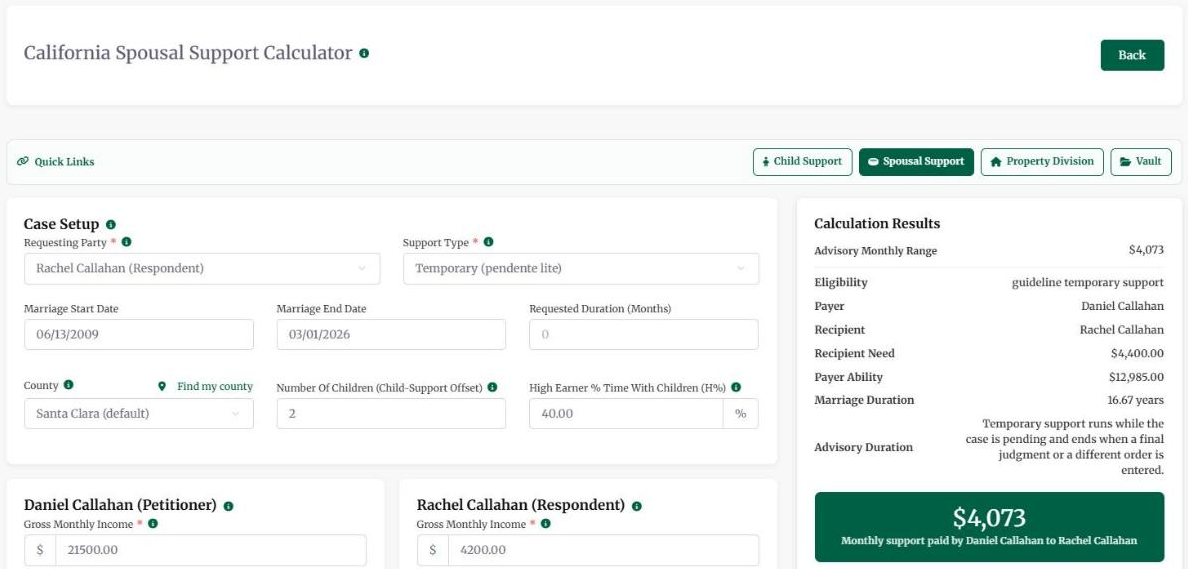
SecureSplit® runs state-specific spousal support calculations from the same intake data your team already collected. See how SecureSplit® works for paralegals.
What Records Prove Each Alimony Factor?
Each factor needs paper behind it, and most of that paper comes from four places: tax returns, pay records, account statements, and each spouse’s sworn budget. The table below pairs each factor with the records that usually prove it.
| Factor | Records that prove it | Watch for |
|---|---|---|
| Income | Tax returns with all schedules, W-2s, 1099s, recent pay stubs, K-1s and profit-and-loss statements for business owners | Income that moves through a business |
| Earning capacity | Resume and work history, licenses, education records, job postings in the field. A vocational evaluation if it’s contested | A drop in earnings right before filing |
| Length of marriage | Marriage certificate and the petition’s filing date | Some states measure to filing, not to the decree |
| Standard of living | At least 12 months of bank and credit card statements, housing costs, car payments, travel, school costs | Spending that changed after separation |
| Need | Each spouse’s financial affidavit or monthly budget | Inflated or missing line items |
| Ability to pay | The payer’s budget, debts, and any other support orders | Prior support obligations |
| Contributions | Employment gaps, proof of supporting a spouse through school or licensing, child care history | Contributions that live in no document. Get a written timeline |
| Children | Parenting plan and child care costs | Overlap with child support figures |
Two items in that table catch people off guard. In Illinois, the statutory formula only applies when the payor has no support obligation from a prior relationship, so prior orders change the whole calculation. In Massachusetts, income a judge already used for a child support order doesn’t count again for alimony.
Pro Tip: Pull at least 12 months of statements for the lifestyle picture. A single month hides yearly costs like tuition, insurance premiums, and travel. Twenty-four months is better when spending shifted around the separation.
Our list of the financial documents you need before divorce covers the full set. Once the documents are in, the real work is turning financial disclosure into insight a judge can follow.
Quick Win: Send the client a records checklist on day one. Statements take weeks to gather, and the request can’t be built without them.
What Can Limit or Rule Out Alimony?
The most common limits are a short marriage, no real need, and no ability to pay. Some states also set hard thresholds in the statute.
- Texas generally requires a marriage of at least 10 years, and the spouse asking must lack enough property or income to meet minimum reasonable needs. Exceptions include family violence, disability, and caring for a disabled child.
- Colorado’s advisory guidelines apply only to marriages of at least three years.
- Florida doesn’t allow durational alimony after a marriage of less than three years. Bridge-the-gap and durational alimony end when the recipient remarries.
- Florida also lets the court consider a supportive relationship, such as living with a new partner, as a factor.
None of these is the whole story in any one case. They are the lines that come up most often when someone asks whether a spouse qualifies.
Where SecureSplit® Fits
A support request is only as strong as the numbers behind it, and those numbers usually live in several different places. SecureSplit® keeps them in one file. Client intake collects income, budget, and statement data. State-specific spousal support calculators run from that same data, and court-ready reports come out of the same file.
That means the paralegal isn’t retyping a pay stub into three different tools the week of a hearing. The attorney reviews one set of numbers, with the source behind each one. Firms can see how it works for family law attorneys and for paralegals.
Frequently Asked Questions
Does a spouse get half of the other’s income in alimony?
No. None of the state formulas or caps covered here gives half. Statutory caps run from 20% of the payer’s gross monthly income in Texas to 40% of combined income in Illinois, New York, and Colorado. Massachusetts generally caps alimony at 30–35% of the difference between the two gross incomes.
Can a spouse who refuses to work still get alimony?
Possibly, but courts look at earning capacity, not just current pay. Illinois weighs each party’s “realistic present and future earning capacity,” and Massachusetts asks whether a spouse could be employable with reasonable effort and training. Massachusetts lets the court attribute income to an unemployed or underemployed spouse, and Colorado calculates maintenance on potential income when a spouse is voluntarily unemployed or underemployed.
What qualifies a spouse for alimony?
A real need for support and a spouse with the ability to pay. In Florida, the person asking for alimony must prove both before the court even weighs the other factors. Other states apply similar thresholds, sometimes with a minimum marriage length.
How long do you have to be married to get alimony?
It depends on the state. Texas generally requires a 10-year marriage for court-ordered maintenance. Colorado’s advisory guidelines start at three years, and Florida won’t award durational alimony after a marriage of less than three years. In states without a set minimum, marriage length is one factor among many.
Is alimony based on gross or net income?
It varies by state. Massachusetts and Texas work from gross income. Illinois uses net income in its guideline formula, and Florida caps durational alimony using the difference between net incomes. Check which one your state’s statute or worksheet asks for before you enter a number.
Is alimony taxable?
For divorce or separation agreements executed after 2018, the payer can’t deduct alimony and the recipient doesn’t count it as income, according to IRS Topic 452. Agreements executed before 2019 follow the old rules unless a later modification adopts the new ones.
Build the Support Request on Proof
Alimony is based on need, ability to pay, and the factors in your state’s statute. A judge can only weigh what’s in the file, so the strongest requests tie every factor to a document. That means tax returns for income, statements for lifestyle, and a budget for need.
SecureSplit® keeps intake, support calculations, and reports in one place, so the paralegal spends the week before a hearing checking numbers instead of hunting for them. See how SecureSplit® works for paralegals.