TL;DR
- A certified divorce financial analyst (CDFA®) is a financial professional certified by the Institute for Divorce Financial Analysts (IDFA®) to handle the money side of divorce.
- On a case, a CDFA® gathers and checks the financial records, models settlement options, and shows the client and attorneys how each option plays out over time.
- To earn it, you need a degree plus 3 years of relevant experience (or 5 years without a degree), about 40 hours of coursework, and a 150-question exam.
- Tuition runs $495 to $1,875, plus $345 a year to keep the designation.
- It pays off most for advisors who already see clients going through divorce.
If divorce cases keep landing on your desk, you've probably noticed they don't behave like normal planning work. The client is stressed, the records arrive in pieces, two attorneys want different numbers, and everyone wants to know what happens to the house.
The certified divorce financial analyst designation was built for that kind of case. This guide covers what CDFAs do day to day, what it takes and costs to earn the designation, how it compares with the CFP, and whether it's worth it for your practice. SecureSplit was built by a CDFA®, so much of what follows comes from inside the work.
What Is a Certified Divorce Financial Analyst®?
A certified divorce financial analyst is a financial professional certified by the Institute for Divorce Financial Analysts (IDFA®) to analyze the financial side of a divorce. The designation was once called Certified Divorce Planner (CDP), according to FINRA's professional designation listing.
Certified Divorce Financial Analyst® (CDFA®): A financial professional certified by the Institute for Divorce Financial Analysts to analyze property division, support, retirement assets, and long-term cash flow in a divorce. CDFAs work with clients, attorneys, and mediators. They do not give legal advice.
Most CDFAs are financial advisors and planners. IDFA® also accepts people from family law practice, and from fields like tax, real estate lending, and insurance, as long as they meet the experience rules covered below.
Key Insight: A CDFA® does not replace the attorney. The attorney handles the law, and the CDFA® shows what each settlement option means in dollars, this year and twenty years from now.
What Do CDFAs Do on a Case?
CDFA® work on a case follows a repeatable path: set the scope, gather the records, check them, sort the property, run the numbers, explain the options, and help carry out the deal. SecureSplit co-founder Jamie Lima, CFP®, CDFA®, built that path into the DIVORCE Framework, and its seven phases make a good map of the job.
How CDFA® Case Work Flows
| D | I | V | O | R | C | E |
|---|---|---|---|---|---|---|
| Develop | Intake | Validate | Organize | Run analysis | Communicate | Execute |
| Set scope and goals | Collect the records | Check the numbers | Sort marital vs separate | Model the options | Walk through results | Carry out the deal |
The seven phases of the DIVORCE Framework, developed by Jamie Lima, CFP®, CDFA®
| Phase | What the CDFA® does | What it produces |
|---|---|---|
| Develop | Sets the scope, the fee, and the client's goals | Engagement letter |
| Intake | Collects statements, tax returns, pay stubs, and retirement and debt records | A complete document set |
| Validate | Checks every number against its source document and flags gaps | Clean data |
| Organize | Sorts assets and debts into marital and separate | Marital balance sheet |
| Run analysis | Models property splits, support, and retirement division | Scenario results |
| Communicate | Walks the client and attorneys through the options side by side | Client-facing report |
| Execute | Helps carry out the settlement, such as tracking retirement transfers | Follow-up checklist |
Gathering and checking the data
Intake and validation usually take the most back-and-forth, because clients send records in pieces. The checking statement shows up one week. The 401(k) statement shows up three weeks later with page two missing.
Every scenario you run later depends on these numbers, so one wrong balance at intake follows the case all the way to the settlement table. Picture a client who remembers a second brokerage account the week before mediation, and every scenario has to be rerun.
Running the scenarios
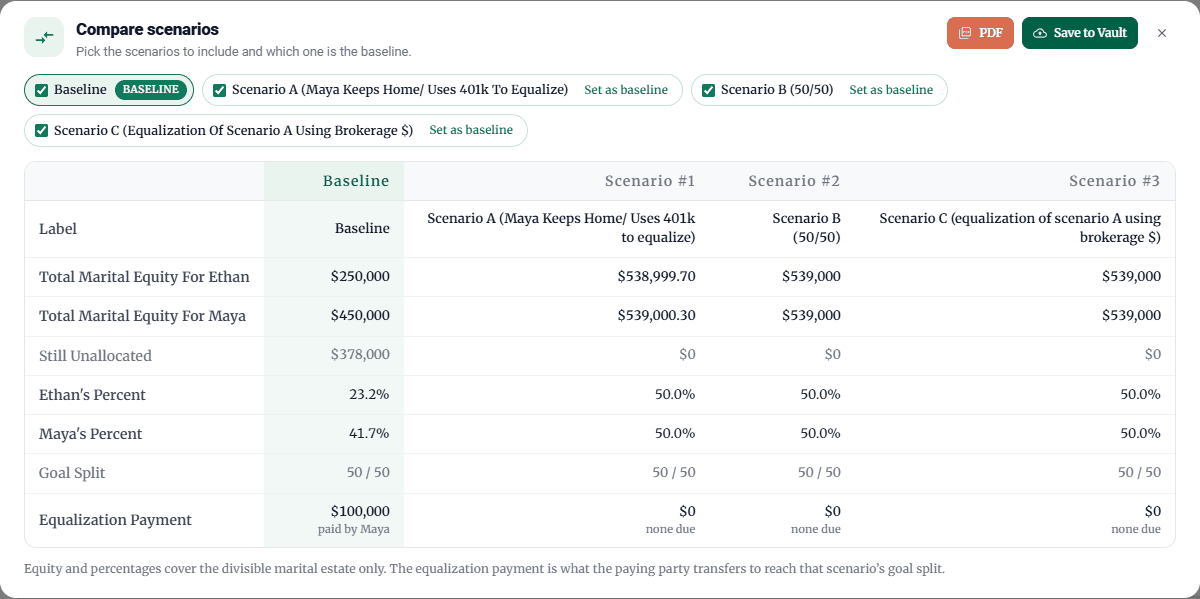
The core of CDFA® work is showing two or three settlement options side by side, with the cash flow behind each one over time. A common example is a client choosing between keeping the house and taking a larger share of the retirement account. On a balance sheet the two can look equal. Over ten years, once upkeep, liquidity, and taxes come into it, they rarely stay equal.
That side-by-side view is what helps a client move off a fixed position. Our post on divorce scenario modeling goes deeper on how to build those comparisons.
Pro Tip: Show every scenario on the same report layout so the client can compare the numbers directly. A new format for each option makes clients compare the formatting instead of the outcome.
Who Works With a CDFA®?
CDFAs are hired in three main ways: by a divorcing client directly, by one spouse's attorney, or as a neutral expert serving both sides in mediation or a collaborative divorce. As a client's own advisor, you work for one side. As a neutral, you give both sides the same numbers so the attorneys can negotiate from one set of facts.
Those referral and neutral roles are why CDFA® work fits alongside attorneys instead of competing with them. Michael Kitces made the same point in his look at the CDFA® as a niche: good relationships with divorce attorneys can become a steady source of referrals.
Quick Win: IDFA® members get 25% off their first year of SecureSplit, a platform built by a CDFA® to run intake, scenarios, and client reports in one place. See the IDFA® member offer.
How Do You Become a CDFA®?
You need qualifying experience, about 40 hours of IDFA® coursework, and a passing score on a four-hour exam. IDFA® designs the program to be finished within a year, and most candidates finish in three to four months, according to IDFA's FAQ.
Eligibility
IDFA® requires a bachelor's degree plus three years of relevant experience, or five years of relevant experience without a degree. Relevant experience means financial planning, family law practice, or work in three or more of these areas, per IDFA's course page:
- Tax
- Investment advisory or management
- Real estate, mortgage, and reverse mortgage lending
- Life and disability insurance
- Financial therapy or coaching
Watch Out: IDFA® has to approve your experience before you use the CDFA® marks. Passing the exam alone doesn't let you put the letters on your business card.
Program options and cost
| Option | Format | Price |
|---|---|---|
| Exam only | Exam voucher, no coursework | $495 |
| Self-study | PDF or hard copy text | $1,600 (PDF) / $1,675 (hard copy) |
| Self-paced eLearning | 10 modules with video lectures and quizzes | $1,675 |
| Virtual classroom | 10 weekly live classes | $1,875 |
| Retake | Per attempt, after a 30-day wait | $225 |
| Annual renewal | Keeps the designation active | $345 a year |
Prices as of October 2026, from IDFA's course page and FAQ. Check IDFA® for current tuition.
If you already hold the CFP, the program also counts for 20.5 hours of CFP Board credit.
The exam
The CDFA® exam has 150 multiple-choice questions and a four-hour time limit, taken at a Prometric testing center. A score of 75% passes, per IDFA®. You can take it no more than three times in any 12-month period.
Keeping the designation
Once you're certified, you pay $345 a year, complete continuing education every two years (including ethics hours), and follow IDFA's Code of Ethics. IDFA's ethics committee can sanction or revoke the designation for violations.
CDFA® vs CFP vs CPA vs Forensic Accountant
The CDFA® is the only one of these four credentials built around divorce. The others cover the full financial plan, tax, or investigation work, and many divorce specialists hold two of them. Jamie Lima, for example, holds both the CFP and the CDFA®.
| Credential | Main focus | Role in a divorce case |
|---|---|---|
| CDFA® | The financial side of divorce | Models settlement options and long-term outcomes |
| CFP | The client's whole financial plan | Plans for the client before and after the divorce |
| CPA | Tax and accounting | Prepares returns and answers tax questions |
| Forensic accountant | Tracing and investigation | Finds hidden or mixed assets and values businesses |
On a complex case you might see three of them at once. The forensic accountant traces where the money went, the CPA handles the tax returns, and the CDFA® pulls it all into settlement options the client can understand.
Is the CDFA® Worth It?
The CDFA® pays off when divorce cases are already part of your practice, or you want them to be. It's harder to justify if you see one divorcing client every couple of years.
Here's what the decision comes down to:
- The cost. Plan on $495 to $1,875 up front, $345 a year after that, and continuing education every two years.
- The credibility. Michael Kitces called the CDFA® a credible, legitimate designation, and IDFA® lists Ameriprise, Morgan Stanley, Raymond James, Wells Fargo, and Edward Jones among the firms that recognize it.
- What the work pays. Experian puts typical CDFA® fees at about $120 to $250 or more per hour. A 2017 Kitces profile described one divorce-focused advisor charging $325 an hour as a neutral, with fees often reaching $10,000 to $12,000 per collaborative case. Treat that as one practice's numbers, from several years ago.
- Where the clients come from. Most divorce work arrives through attorney and mediator referrals. If you won't spend time building those relationships, the designation alone won't fill your calendar.
For some advisors, the opportunity is big enough to go all in: Jamie Lima, the CDFA® behind the DIVORCE Framework, sold his wealth management practice to focus solely on divorce financial analysis.
What Tools Do CDFAs Use?
Most CDFAs start on spreadsheets and move to divorce-specific software once case volume grows. Spreadsheets work for a handful of cases. They get painful once every scenario needs its own tab and an attorney asks how a number was calculated.
| Spreadsheets | General planning software | Divorce financial platform | |
|---|---|---|---|
| Secure client document intake | No | Varies | Yes |
| Support and property calculations | Built by hand | Limited | Yes |
| Side-by-side settlement scenarios | Built by hand | Limited | Yes |
| Client-ready reports | Formatted by hand | Yes | Yes |
| Shows its work for attorneys | Depends on the file | Varies | Yes |
Our post on why spreadsheets fall short in divorce financial planning covers where they break down.
SecureSplit is the platform we built for that last column. It was built by a CDFA®, it's a trusted IDFA® software provider, and it runs a whole case in one place, intake through client-ready report. Clients upload documents through a secure portal, and you run support and property calculations, compare scenarios side by side, and produce reports that show how each number was reached. See how SecureSplit works for financial professionals, or read more about tools that help CDFAs bring clarity to a case.
Frequently Asked Questions
What does a certified divorce financial analyst do?
A CDFA® gathers and checks a divorcing client's financial records, models settlement options, and shows how each option affects the client's finances over time. CDFAs work alongside attorneys and mediators and do not give legal advice. Some work for one spouse, and some serve as a neutral expert for both sides in mediation or collaborative divorce.
How much does it cost to become a CDFA®?
IDFA's tuition runs from $495 for the exam only to $1,875 for the virtual classroom, as of October 2026. Retakes cost $225, and the designation renews for $345 a year. The self-study and self-paced eLearning options fall in between at $1,600 to $1,675.
How long does it take to become a CDFA®?
IDFA® designs the program to be finished within one year, and most candidates finish in three to four months. The coursework is about 40 hours, followed by a four-hour, 150-question exam at a Prometric testing center. IDFA® also has to approve your experience before you can use the CDFA® marks.
Is the CDFA® designation worth it?
It pays off most for advisors and attorneys who already work with clients going through divorce, and it is recognized by firms such as Morgan Stanley, Raymond James, and Wells Fargo. It is harder to justify the yearly renewal and continuing education if divorce cases are rare in your practice. Attorney referrals usually decide how much work the designation brings in.
What is the difference between a CDFA® and a CFP?
A CFP covers a client's full financial plan, while a CDFA® is trained specifically on the financial side of divorce, including property division, support, and retirement splits. Many divorce specialists hold both. The CFP helps with planning before and after the divorce, and the CDFA® covers the settlement itself.
How much does a CDFA® charge?
Published ranges run about $120 to $250 or more per hour, according to Experian. Many CDFAs offer a free first consultation. Total cost depends on how complex the case is, how organized the records are, and whether the CDFA® works for one spouse or as a neutral for both.
Pro Tip: Anyone can check whether a professional holds the designation in IDFA's Find a CDFA® directory.
Next Steps for New CDFAs
Once you hold the designation, the work comes down to clean data, clear scenarios, and reports your clients understand. The free DIVORCE Framework training walks through the seven phases on live sessions, taught by the CDFA® who built SecureSplit.
When you're ready to run cases in one place, IDFA® members can get 25% off their first year of SecureSplit. Or book a 30-minute demo and see a case run start to finish.